
Hybrid Work Is Settling In—But Not Where Many Expected
For the past several years, hybrid work has been framed as a temporary compromise: a bridge between pandemic-era flexibility and a presumed return to office-centric norms. Our polling data from 2023 through 2026 suggests something more nuanced is happening. Hybrid work isn’t disappearing—it’s consolidating.
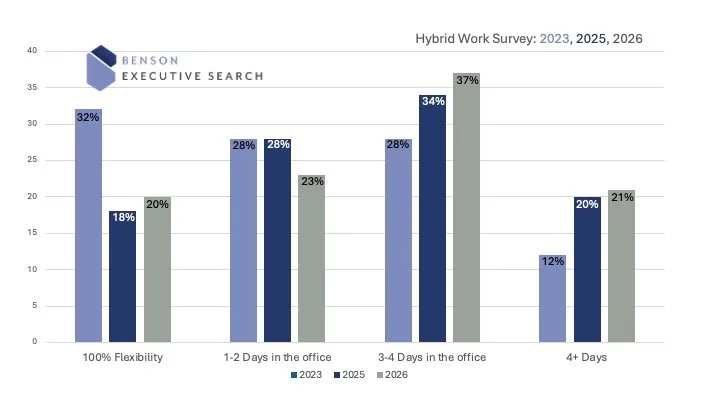
In 2023, organizations were widely dispersed across models. Nearly one-third of respondents (32%) reported fully flexible work arrangements, while hybrid options were evenly split between 1–2 days (28%) and 3–4 days in office (28%). Only 12% required full-time, in-office work. At that point, flexibility was still being used as a retention tool in a volatile labor market.
By 2025, the picture began to sharpen. Fully flexible arrangements dropped sharply to 18%, while full-time in-office roles rose to 20%. Most notably, the 3–4 day hybrid model became the most common structure, increasing to 34%. Employers were no longer experimenting—they were choosing.
Our 2026 findings confirm that trend. The dominant model is now clearly defined: 38% of organizations operate with a 3–4 day in-office expectation, while another 20% require four or more days onsite. Fully flexible work rebounded slightly to 20%, but remains well below its 2023 peak. Meanwhile, lighter hybrid models (1–2 days) declined to 22%.
What does this tell us? Hybrid work is no longer about maximum flexibility; it’s about intentional presence. Organizations are prioritizing collaboration, culture, and leadership development—particularly for early-career talent—while still preserving some degree of autonomy for employees.
For HR leaders, the implication is clear: hybrid strategy has become a leadership issue, not a perk. Candidates are no longer asking if there is flexibility, but how it works—and whether expectations are consistent, fair, and tied to business outcomes.
The era of broad, open-ended flexibility may be ending. In its place is a more structured, middle-ground model—one that rewards clarity and a compelling reason to come into the office.